Careers
We INSPIRE our students to explore a limitless range of training and career pathways.
We celebrate their SUCCESS by reflecting on where their achievements and skills can take them.
We care about our COMMUNITY by working with business partners to build the skilled and creative workforce of the future.
We have AMBITION for every single child to seek aspirational and meaningful destinations.
The Gatsby Benchmarks
Isca Academy’s 5-year Careers Programme is guided by the Gatsby Benchmarks, but not limited to them. We gather feedback and adapt our programme to meet each cohort’s needs and interests. We respond to local, national and global Labour Market Information.
What are the Gatsby Benchmarks?
The Gatsby Benchmarks are statutory, and define what world-class careers provision in education looks like and provide a clear framework for organising the careers provision in schools.
The 8 Gatsby Benchmarks are:
-
A stable careers programme
-
Learning from careers and labour market information
-
Addressing the needs of each student
-
Linking curriculum learning to careers
-
Encounters with employers and employees
-
Experiences of workplaces
-
Encounters with further and higher education
-
Personal guidance
Read more about the Gatsby Benchmarks: https://www.careersandenterprise.co.uk/educators/gatsby-benchmarks/
Isca Academy’s Careers Leader is Marie Knights
Contact: [email protected]
The Careers Programme
Each year group has a bespoke Careers Programme, which combines assemblies, tutor time activities, LVS lessons, and additional visits and experiences. All students track their Careers experiences and skills on Unifrog so that they have a record of their progress as they begin shaping their futures. We have frequent speakers and industry experts. Many students are also selected for targeted Careers Mentoring.
The effectiveness of the Careers Programme is based on feedback from the Future Skills Questionnaire, along with statistics and student evaluations on Unifrog. A good Careers Programme will ensure students make informed choices for their next steps and beyond. They will remain in their post-16 destinations because they are well-suited to their needs and desired pathways, and our young people will feel empowered with the knowledge and skills with which to make their Career choices.
Last review date: January 2025.
Next review date: January 2027.
Links to year 7-11 programmes here.
Unifrog
Unifrog is a dedicated all-inclusive platform that students use regularly for their Careers activities. It is full of useful activities, videos, job profiles and search tools to suit all learners and help to guide their research. Students can write and store CVs, personal statements and applications to use in the future. Parents/Carers can also access Unifrog with their log-in. A link to this log-in will be sent to the email address provided to the school upon registration.
We would urge all school leavers to input their personal email address into Unifrog so that they can keep their Careers record and update us on their progress post-16.
Post-16 progression
There is no set course or destination for students; there are many different pathways and meaningful destinations to suit every learner. Each young person is different and will receive personalised support. A ‘meaningful destination’ means a student has purposefully chosen their next steps, at a level that suits them, and progresses on to their next career goal.
If students pass their GCSEs at level 1 (grades 1-3), they usually progress on to an entry level, a level 1 or level 2 course, or equivalent training after leaving Isca.
If students pass their GCSEs at level 2 (grades 4-9), they usually progress on to level 3 courses or equivalent training after leaving Isca.
Common post-16 qualifications
A-levels are academically rigorous level 3 qualifications that are primarily classroom-based and are assessed by external exams. They require independent study. Students can do A-levels at schools or colleges; each establishment will offer different subjects with differing entrance requirements. A-levels can lead on to university, apprenticeships, further training or employment.
BTECs are high-quality career-focussed qualifications grounded in the real world of work. They are practical and more coursework based, although there are usually some external assessments. They are developed with employers, so they offer knowledge and skills that employers are seeking. Level 3 BTECs (National) are equivalent to 3 A levels. A level 2 BTEC is roughly equivalent to GCSEs. BTECs can lead on to university, apprenticeships, further training, higher level BTECs or employment.
T-levels are newer qualifications. They are 2-year industry-focussed qualifications, equivalent to 3 A-levels. Students spend 80% of the time in the classroom, and 20% in an industry placement. If you want to know more, check out this link: https://www.tlevels.gov.uk/
Apprenticeships are available at all levels and in many industries. They are not just for school leavers and can be accessed at any point post-16. Apprentices spend 20% of their time in the classroom, and 80% in a work placement. Apprentices receive a wage and a qualification, and a large percentage of students are retained by the company that’s trained them once their apprenticeship finishes. To find out more, click this link: https://www.apprenticeships.gov.uk/
There is a whole range of other courses and qualifications to suit every young person, and we have a team of people at Isca who can help guide our students through it all.
If you would like to speak to our Post-16 transition coordinator, please email: [email protected]
Impartial Careers guidance and one-to-one support
Every single student has at least one meeting with a qualified and impartial advisor in year 10 or 11. Additionally, students can see an advisor as many times as they wish until they have applied for meaningful post-16 destinations. Support also continues after year 11 results day to ensure smooth and sustained transition.
Exeter College and Bicton College advisors can also meet with students at their request, as we have established connections and relationships with these providers, and work closely with them.
If students pass their GCSEs at level 1 (grades 1-3), they usually progress on to an entry level, a level 1 or level 2 course, or equivalent training after leaving Isca.
If students pass their GCSEs at level 2 (grades 4-9), they will usually progress on to level 3 courses or equivalent training after leaving Isca.
There is no set course or destination for students; there are many different pathways and meaningful destinations to suit every learner. A ‘meaningful destination’ means a student has purposefully chosen their next steps, at a level that suits them, and progresses on to their next career goal.
Encounters with employers, employees, training providers and workplaces
Work experience-based activities: as well as Work Experience week in year 10, all students in years 7-9 will have at least 25 hours of work experience-based activities, as well as additional visits and career-focussed encounters.
Provider Access Legislation: we welcome all employers and training providers. If you are interested in supporting our students, please contact the Careers Leader: [email protected]
Isca’s annual Careers Fair: each year in March, Isca welcomes a wide range of employers and training providers to its Careers Fair, which is attended by all students. If you would like to be involved in Careers Fair 2026, please complete the business partner form
Year 10 Work Experience
What is Work Experience?
Year 10 Work Experience usually takes place during the final week of the summer term. Students do not come to school during Work Experience week; they go to their work placement that they have organised and carry out relevant and reasonable tasks set by the employer, building workplace knowledge and skills. They make their own way to and from their placement.
Why do Work Experience?
Labour market feedback tells us that a large number of employers now require a candidate to have carried out work experience before they will even interview them for a job. We encourage our young people to look for meaningful placements in career sectors that they are interested in.
Spending time in an employment setting can be invaluable for:
-
Developing transferable ‘soft’ skills such as teamwork and communication
-
Understanding how organisations work
-
Giving learning a real-world context
-
Learning from experienced people
-
Confirming or challenging an interest in a particular career sector
-
Creating networks; the opportunity to get a job or apprenticeship
-
Creating skills and experience to write about in applications and on a CV, and discuss at interviews
Who organises the work placement?
Students are responsible for finding and arranging the placement. They are supported to do this by their tutor. Families can help too. Writing formal emails, making phone calls and communicating arrangements are important life skills for our young people to learn and practise.
How do students find a placement?
Students should try to secure a placement as early as possible in year 10. They should:
-
Think about the employment sector or job they’re interested in.
-
Consider the environment they’d like to work in (outdoors/office/school etc)
-
Ask family, friends and other connections for ideas
-
Search for the contact details (email address and phone number) of anything of interest, and start contacting employers.
-
Keep a record of everything they’ve applied for, and don’t be scared to prompt businesses if you don’t hear back within a week.
-
Don’t be put off if an employer doesn’t reply or can’t do a placement; this is normal – keep trying!
Work Experience process:
|
|
|
|
|
|
|
|
|
|
Restrictions:
-
We can only approve placements during the official Work Experience week.
-
Placements abroad cannot be approved by us.
-
Students cannot do work experience with lone workers or sole traders (including close family members) unless they have Employer’s Liability Insurance.
Work Experience placement ideas:
-
Schools
-
Childcare settings
-
The Met Office
-
NHS services
-
Law firms
-
Accountancy firms
-
National Trust properties
-
Construction companies
-
University of Exeter
-
Architectural/design companies
-
Healthcare/surgeries/pharmacies
-
Retail/shops
-
Hair and beauty/salons
-
Theatres
-
Sports clubs
-
Restaurants/cafés
-
Garages
-
Exeter airport
-
GWR
Labour Market Information
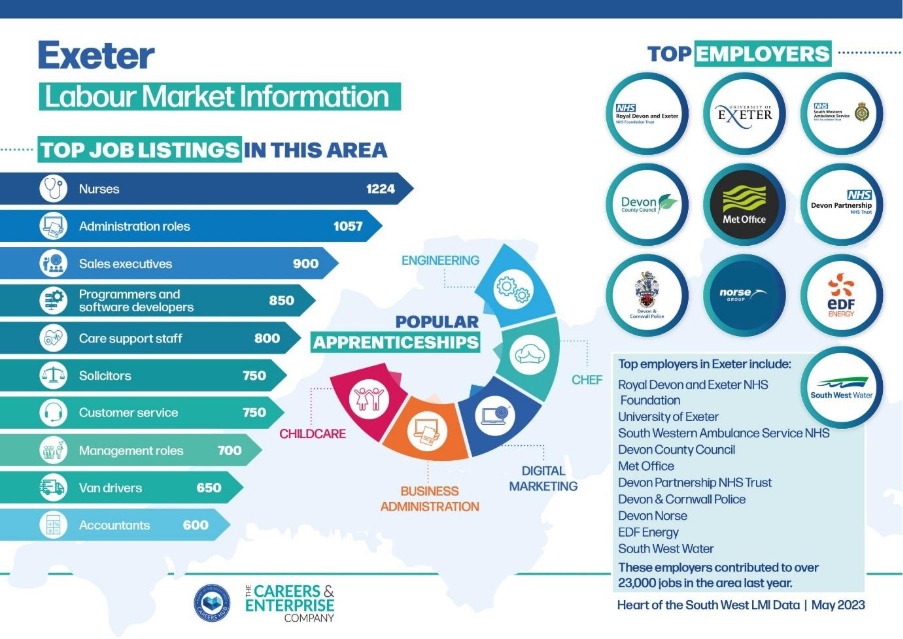
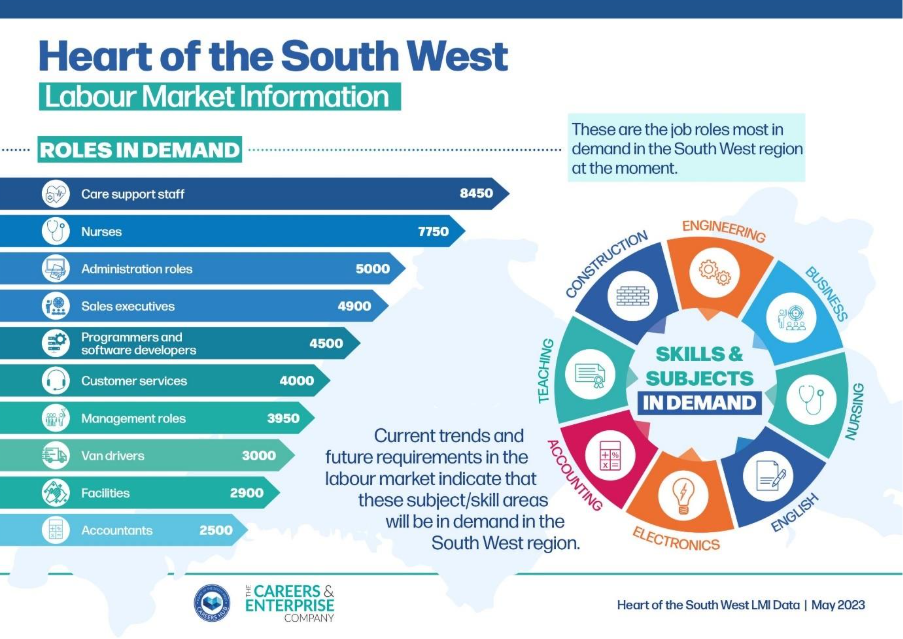
LMI gives us information on global, national and local employment trends that we can use to inform our Careers programme, making it relevant to the learners of today and the workforce of the future.
Globally, high-demand employment sectors include technology (AI, big data, cybersecurity), health care, finance, and sustainability.
Nationally, the most in-demand employment sectors are in health and social care, education and finance industries. However, the UK’s largest growth sectors are Information Technology, Healthcare and Construction (including green energy).
In Exeter, the largest employment sectors are healthcare, science and technology, education, local government. Exeter’s unemployment figures are slightly below national statistics, while Exeter has a higher than national number of economically active women. A full report of current economic activity for Exeter can be found here: https://www.nomisweb.co.uk/reports/lmp/la/1946157359/report.aspx#tabempunemp